Business Isolation Due to Coastal Flooding in Aotearoa
Dr Sarah Harrison
Researcher
12 min

Urban Intelligence® completed an assessment for He Pou a Rangi Climate Change Commission on how coastal flooding isolates businesses from essential services. Over 15,000 businesses are already at risk under present-day sea levels during a 1% AEP event, rising to 1-in-10 nationally at 1.0m of sea-level rise, with seven territorial authorities facing more than a third of their businesses isolated. The findings give councils and industries a national baseline to guide adaptation planning and track risk as sea levels rise.
The Risk of Business Isolation from Coastal Flooding.
Coastal flooding, or coastal inundation, can range from minor nuisance events through to severe storm surges capable of damaging buildings, flooding roads, disrupting businesses, and cutting off residents. Such events may isolate businesses from the critical services and transportation networks they require to function, resulting in economic impacts even if the businesses themselves are not directly exposed.
Urban Intelligence recently completed an assessment to inform He Pou a Rangi Climate Change Commission’s evidence base on the risk that current and future coastal flooding poses to the isolation of businesses. This provides the basis for monitoring changes in isolation over time to determine if adaptation actions are reducing risk to businesses and, by extension, risks to the economy and social outcomes.
What is Business Isolation?
For the purposes of this assessment, we considered a business to be isolated if no viable driving route exists between the property and a set of essential destinations - fire stations, hospitals, and primary and secondary schools. These destinations act as proxies for broader access to essential services and a disruption in the transport network more generally. By extension, disrupted access to wider networks leads to business continuity challenges.
Why is Business Isolation Important?
An isolated business may, over time, become less viable. When a business is isolated, even if just for a short time around high tide, there is a potential impact on staff, customer, and supplier access, all of which affects the ability of the business to operate. Any reduced ability to operate potentially affects both employee income and business income. Income reduction can impact the long-term viability of the business, with flow-on effects for the local economy and the wider community. In short, even though there is no damage to the building or goods and services, repeat frequent isolation events could have a lasting impact.
For more information about cascading impacts, see our report for He Pou a Rangi Climate Change Commission on cascading risk archetypes.
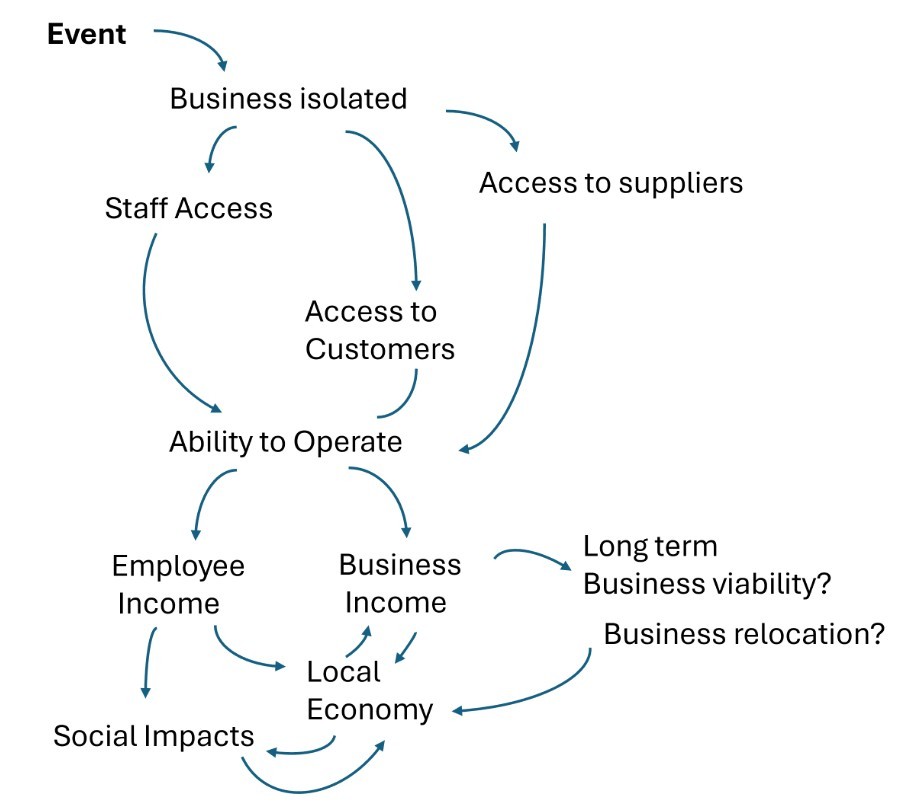
The potential cascading impacts of business isolation over time.
How We Assessed Business Isolation Risk
We combined national-scale coastal flood hazard data, property-level business information, and transport network analysis to determine whether businesses retain access to essential destinations under a 1% Annual Exceedance Probability (AEP) coastal flood event.
The analysis involved four steps:
Coastal flood hazard extents are defined for present-day conditions and three increments of sea-level rise (0.2 m, 0.5 m, and 1.0 m).
Businesses and their associated employment and industry classifications are attributed to individual properties.
The road network is modified to reflect flood-induced disruptions.
Routing analysis is used to determine whether businesses remain connected to essential services.
Results were aggregated to the territorial authority (TA) level and reported by industry sector using ANZSIC 2006 divisions (Australian Bureau of Statistics, 2013).
Findings from the Coastal Flooding Business Isolation Assessment
Economic disruption arising from coastal flooding-related business isolation is not a temporally distant problem. Under present-day sea levels over 15,000 businesses are potentially isolated during a 1% AEP event, and the impacts could begin to exacerbate by 0.2m of sea-level rise. At the national scale, approximately 1-in-10 businesses could experience isolation challenges during a 1% AEP event with 1.0m of sea-level rise. As a result, impacts on business continuity and both regional and national GDP are likely.
The economic impacts of isolation will not be evenly distributed across the country. Certain TAs and sectors face considerably greater isolation-related business interruption than others, and the scale of potential isolation increases substantially with each increment of sea-level rise.
Seven TAs may have more than 1-in-3 businesses isolated during a 1% AEP event at 1.0m of sea-level rise: Thames-Coromandel District, Ōpōtiki District, Napier City, Buller District, Hauraki District, Nelson City, and Kaipara District. This signals a significant level of potential economic impact ahead.
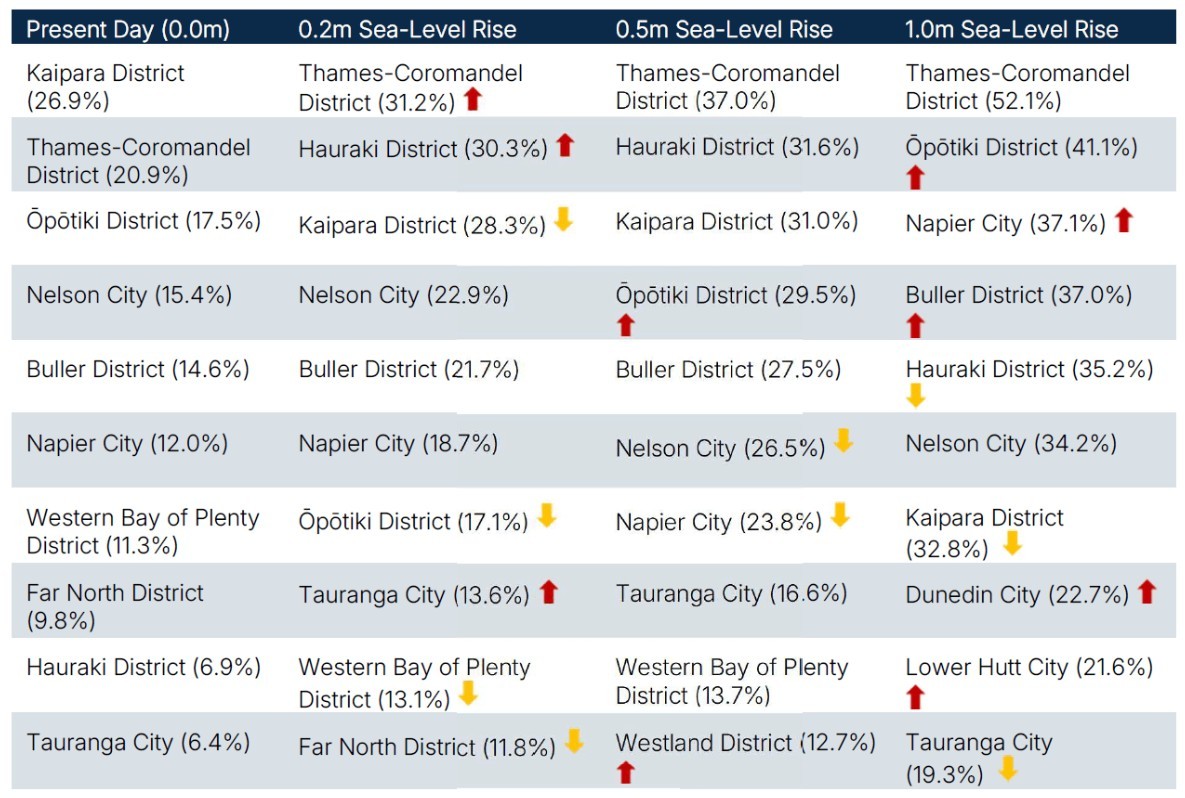
The percentage of businesses potentially isolated due to a 1% AEP coastal flood event at present-day sea levels, 0.2m, 0.5m, and 1.0m of sea-level rise, by TA. A red arrow indicates the percentage of businesses has increased for a particular TA over time relative to other TAs, and a yellow arrow indicates the percentage has decreased for a TA relative to others.
In terms of industry sectors, both the total number and proportion of businesses potentially isolated in each sector increases with each sea-level rise increment. By 1.0m of sea-level rise, all sectors approach (or exceed) double their present-day percentages (number of isolated businesses as a proportion of all businesses in that sector).
By 1.0m, Electricity, Gas, Water and Waste Services has the highest proportion of businesses at risk (13.1%), having risen from 3.2% in 7th position for present-day sea levels.
The Rental, Hiring and Real Estate Services sector has the highest total number of businesses potentially isolated across all sea-level rise increments, increasing from approximately 3,400 (3.5%) under present-day conditions to over 9,000 (9.2%) at 1.0m.
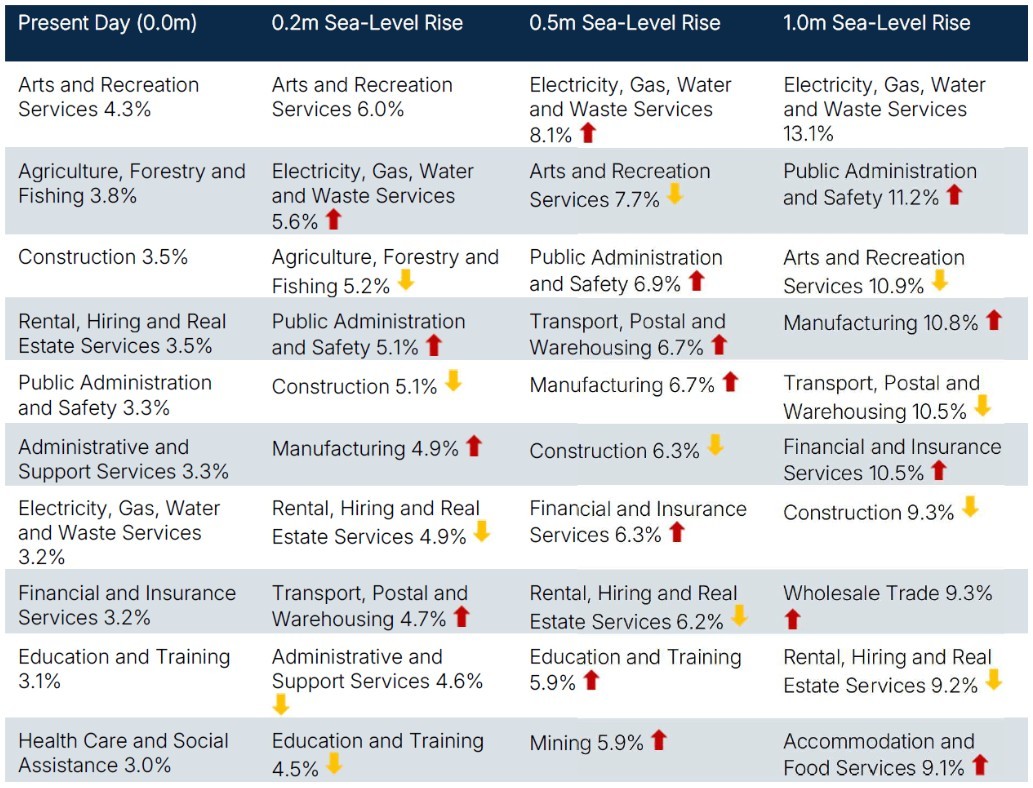
The percentage of businesses potentially isolated due to a 1% AEP coastal flood event at present-day sea levels, 0.2m, 0.5m, and 1.0m of sea-level rise, by ANZSIC Sector classification. A red arrow indicates the percentage of businesses has increased for a particular sector over time relative to other sectors, and a yellow arrow indicates the percentage has decreased for a sector relative to other sectors.
How the Results Can Be Used
Our analysis provides a first-pass national-level assessment of potential business isolation resulting from 1% AEP coastal flooding. By examining isolation at both the national and TA level, the analysis identifies which areas and sectors may be disproportionately affected, both under present-day conditions and across a range of future increments of sea-level rise. In doing so, it establishes an evidence base to inform wider national assessments of coastal flood risk and to support adaptation planning processes at multiple scales. The findings also provide baseline data that can be drawn upon for ongoing risk monitoring and adaptation tracking as sea levels continue to rise.
The findings of this analysis are intended to be of practical value to a range of users. Territorial Authorities and industry sectors can draw on this analysis to further explore local risk profiles and inform local council or sector-led adaptation planning. This includes further exploration of the cascading short- and long-term implications of business isolation for local communities and economies.
References:
Business isolation from coastal flooding in Aotearoa | Resilience Explorer®
Over 15,000 New Zealand businesses could be cut off from essential services in a 1% AEP coastal flood today, rising to 1 in 10 nationally at 1.0 m of sea-level rise.