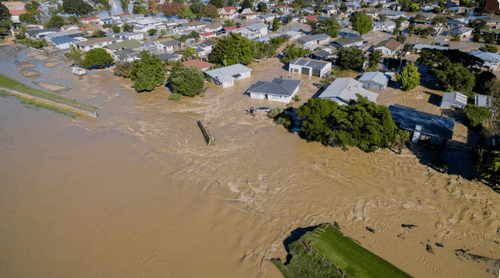
The NPS-NH, NPS-I, and Emergency Management Bill: a new framework for managing natural hazard risk
7 MIN
Maggie Fellowes
Senior Advisor: Climate and Resilience

Two pieces of national direction came into force on 15 January 2026, each targeting a different part of the regulatory system for natural hazard risk. The NPS-NH sets a nationally consistent standard for how risk is assessed in planning and consent decisions for new development. The NPS-I sets national direction for how infrastructure is planned, located, and consented, including how natural hazard risk is managed.
A third instrument, the Emergency Management Bill (No 2), is currently before Parliament and introduces new operational resilience requirements for essential infrastructure providers.
Together they represent a significant shift in how New Zealand manages natural hazard risk across the planning, consenting, and emergency management systems. This series works through each instrument in turn: what it requires, who it applies to, and what it means in practice.
The NPS-NH is now in force: what has changed for planners and consent officers?
The National Policy Statement for Natural Hazards (NPS-NH) came into force on 15 January 2026. If you work in planning, land development, or consenting, or if you are pursuing residential or commercial development, this directly changes how risk must be assessed.
Before the NPS-NH, the RMA required local authorities to manage "significant risk from natural hazards" without ever defining what that meant. This meant that each council approached it differently, hazard overlays varied in quality and coverage, and risk assessments were inconsistent depending on who wrote them, what data they had, and how risk-averse the team was.
The NPS-NH aims to reduce that variability by introducing a nationally consistent likelihood-consequence risk matrix. For the first time, "significant risk" has a defined meaning: any risk assessed as medium, high, or very high using the standardised matrix. The seven hazards it covers are flooding, landslides, coastal erosion, coastal inundation, active faults, liquefaction, and tsunami.
In practice, the evidential bar has shifted. Risk assessments for new subdivision, use, and development must now use a standard method. Very high risk must be avoided and medium and high risk must be managed proportionately. Climate change must be assessed across a minimum 100-year horizon. Residual risk, meaning what remains if mitigation measures fail, must be considered alongside risk with protections in place. The best available information must be used, even where uncertainty remains.
Hazard maps that only show exposure (without consequence assessment, future scenarios, or a clear methodology) will be harder to rely on when defending a decision. Decision-makers need to be able to show they applied the matrix, considered mitigation failure, and looked forward 100 years.
The problem with risk matrices
Risk matrices have well-documented limitations. They can obscure meaningful differences between risks, create cliff-edge effects where a marginal change in one factor shifts a rating dramatically, and reduce a range of scenarios to a single point. In some cases, this produces rankings that work against sound decision-making.
You can read more about this in our dedicated Guide post: Risk Matrices: They Can Mislead More Than They Help https://api.resilience-explorer.com/auth/login?return_path=%2Fapp%2Fguide%2Finsights%2Fcommentary-and-opinion%2Fthe-problem-with-risk-matrices
Our approach in Resilience Explorer
As an extension to Resilience Explorer, we have developed an approach to meet the NPS-NH requirements using the prescribed likelihood–consequence framework that mitigates the common limitations of risk matrices. In this approach, we:
Assess consequences using hazard-specific vulnerability functions, estimating property damage from hazard intensity and assessing life safety against separate thresholds. The higher of the two determines overall risk.
Present multiple scenarios across the matrix, enabling decision-makers to see how risk moves, not just where it lands. Plotting this on a scatter plot means the thresholds are explicit, rather than obscured by the matrix's arbitrary categories.
Clearly state where long-term data does not exist, rather than assuming a rating.
The result is an automated, consent ready assessment that is both compliant and defensible, mapping directly to the NPS-NH framework.
What this means for your team
If you are working through what implementing the changes looks like in practice, or want to understand how Resilience Explorer can help your team meet the new requirements, we are keen to hear from you.
The NPS-I is now in force: what it means for infrastructure and natural hazard risk
The National Policy Statement for Infrastructure (NPS-I) came into force on 15 January 2026, the same date as the NPS-NH. Where the NPS-NH establishes how natural hazard risk must be assessed for new development, the NPS-I takes a different starting point: it recognises that infrastructure often has little choice about where it sits.
Understanding how the two instruments interact is increasingly relevant for infrastructure providers, asset managers, and consent officers working across both regimes.
What the NPS-I covers
The NPS-I applies to all infrastructure and supporting activities, including network utilities as recognised under the Resource Management Act 1991 (transport, water, energy and telecommunications) and additional infrastructure (emergency services, health, education, defence, corrections, waste facilities, stormwater networks, and local flood protection works). There are two exceptions: renewable electricity generation managed under the NPS for Renewable Electricity Generation 2011, and electricity transmission and distribution managed under the NPS for Electricity Transmission 2008.
Its objective is to ensure that infrastructure is well-functioning, resilient, and delivered in a timely and efficient manner while managing adverse effects.
The functional need argument
The NPS-NH restricts new development in areas of high natural hazard risk. The NPS-I cuts across this in a specific way. Policy 2 requires decision-makers to recognise that infrastructure often needs to be located where services are required, including in hazard-prone areas, and risk must be managed rather than avoided entirely.
This reflects the reality that assets like stormwater networks, roads, and electricity infrastructure cannot always be relocated to lower-risk areas. Decision-makers must weigh this functional need alongside the level of hazard risk when assessing infrastructure consents.
Resilience as a reason to act, not just a constraint
Policy 4 of the NPS-I requires decision-makers to enable upgrades to existing infrastructure where doing so will improve resilience to natural hazards and climate change. This means that infrastructure providers seeking consent to upgrade an existing asset in a hazard-prone area have a specific policy basis to rely on, provided the upgrade genuinely improves resilience rather than simply extending exposure.
This provision is practically important for councils and network utilities managing ageing infrastructure in areas where hazard profiles are changing.
The interface with NPS-NH
Policy 9 of the NPS-I addresses this directly. Where proposed infrastructure activities are likely to have adverse effects on environments covered by section 6 of the RMA, the NPS-I provisions must be read alongside other relevant national direction, including the NPS-NH. Together, the two instruments require a considered judgement about functional need, hazard risk, and the proportionality of any mitigation.
The Emergency Management Bill (No 2): what it will require of essential infrastructure providers
The Emergency Management Bill (No 2) is currently before Parliament. If enacted, it would replace the Civil Defence Emergency Management Act 2002 and introduce new requirements for what it terms essential infrastructure providers. For those working across infrastructure planning and resilience, it is worth understanding now, alongside the NPS-I and NPS-NH that came into force in January 2026.
What changes for infrastructure providers
Under the current CDEM Act, essential infrastructure providers are referred to as lifeline utilities. The Bill replaces that term with essential infrastructure providers and introduces a principles-based approach to recognising new providers in that category. While entities are listed in Schedule 3, the approach means that the scope of essential providers can expand over time as infrastructure systems and dependencies evolve.
The core obligation sits in clause 74. Essential infrastructure providers will be required to ensure their infrastructure is able to function to the fullest possible extent during and after an emergency. This is an operational resilience requirement rather than a planning or consent requirement. It sits in a different regulatory space from the NPS-I and NPS-NH, but it points toward the same underlying problem: infrastructure that is inadequately resilient to natural hazards creates cascading consequences for communities.
Sector response plans
Clauses 104 to 106 of the Bill enable the Director-General to develop and approve sector response plans for coordinating how essential infrastructure providers work together during and after an emergency. These plans support coordination across providers, however, each organisation remains responsible for maintaining its own operational readiness.
How this connects to the wider picture
The NPS-NH, NPS-I, and the Emergency Management Bill create three distinct but connected layers of obligation for infrastructure providers. The NPS-NH governs how natural hazard risk is assessed in planning and consent decisions for new development. The NPS-I governs how infrastructure consent decisions are made, including in hazard-prone areas. The Emergency Management Bill governs what providers must do operationally to ensure their infrastructure continues to function when an emergency occurs.
Each instrument has a different purpose and a different decision-maker in mind, but they share a common aim: that infrastructure exposed to natural hazards is resilient enough to serve the communities that depend on it.
We will continue to track this Bill as it progresses through Parliament.
The NPS-NH, NPS-I, and Emergency Management Bill: a new framework for managing natural hazard risk
