What Is Systemic Risk and Why Does It Matter for Communities?
Dr Tom Logan
Chief Technology Officer

Climate change, infrastructure resilience, housing, insurance, public finance, and environmental management are increasingly interconnected. As a result, risks often propagate across systems and are experienced differently by different communities and stakeholders. This article explores what systemic risk means, why it matters for resilience planning, and how practitioners can better understand the consequences, trade-offs, and competing perspectives that shape adaptation decisions.
What Is Systemic Risk? And Why Does It Matter for Communities?
Systemic risk has become a growing focus of governments and international organisations because many of today's most significant challenges do not fit neatly within organisational or sector boundaries. Climate change, energy security, infrastructure resilience, housing affordability, public finance, and geopolitical instability increasingly interact in ways that create consequences across social, economic, environmental, infrastructure, and governance systems.
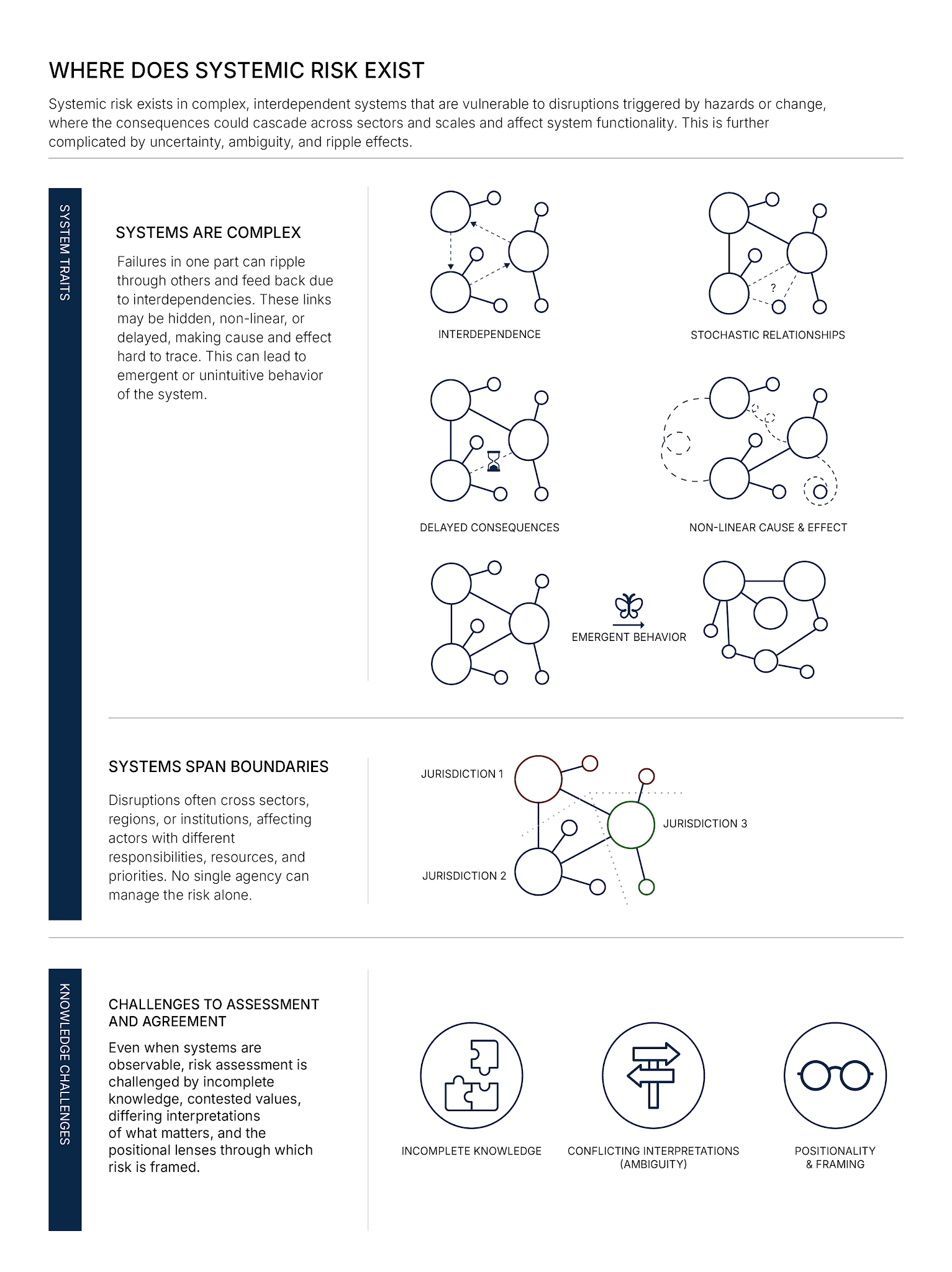
Systemic risk concerns the way consequences emerge from interactions within complex systems, propagate across connected systems, and become experienced, valued, and interpreted differently by the people and organisations affected. As a result, stakeholders may legitimately disagree about which consequences matter most, what constitutes an acceptable level of risk, and what actions should be taken.
In a recent paper published in Risk Analysis, an international group of researchers and I propose a research agenda for advancing systemic risk assessment. The paper is motivated by improving how systemic risk should be assessed in ways that support the governance of these risks.
These challenges are increasingly shaping policy discussions around risk and resilience. For example, the European Commission's proposed European Climate Resilience and Risk Management Integrated Framework, seeks to improve how risks are assessed and managed across sectors, institutions, and levels of government. The framework recognises that understanding individual hazards is no longer sufficient. Decision-makers increasingly need to understand how consequences propagate through interconnected systems, how different interventions interact, how decisions in one domain create outcomes in another, and how to engage with differing, yet legitimate, perspectives.
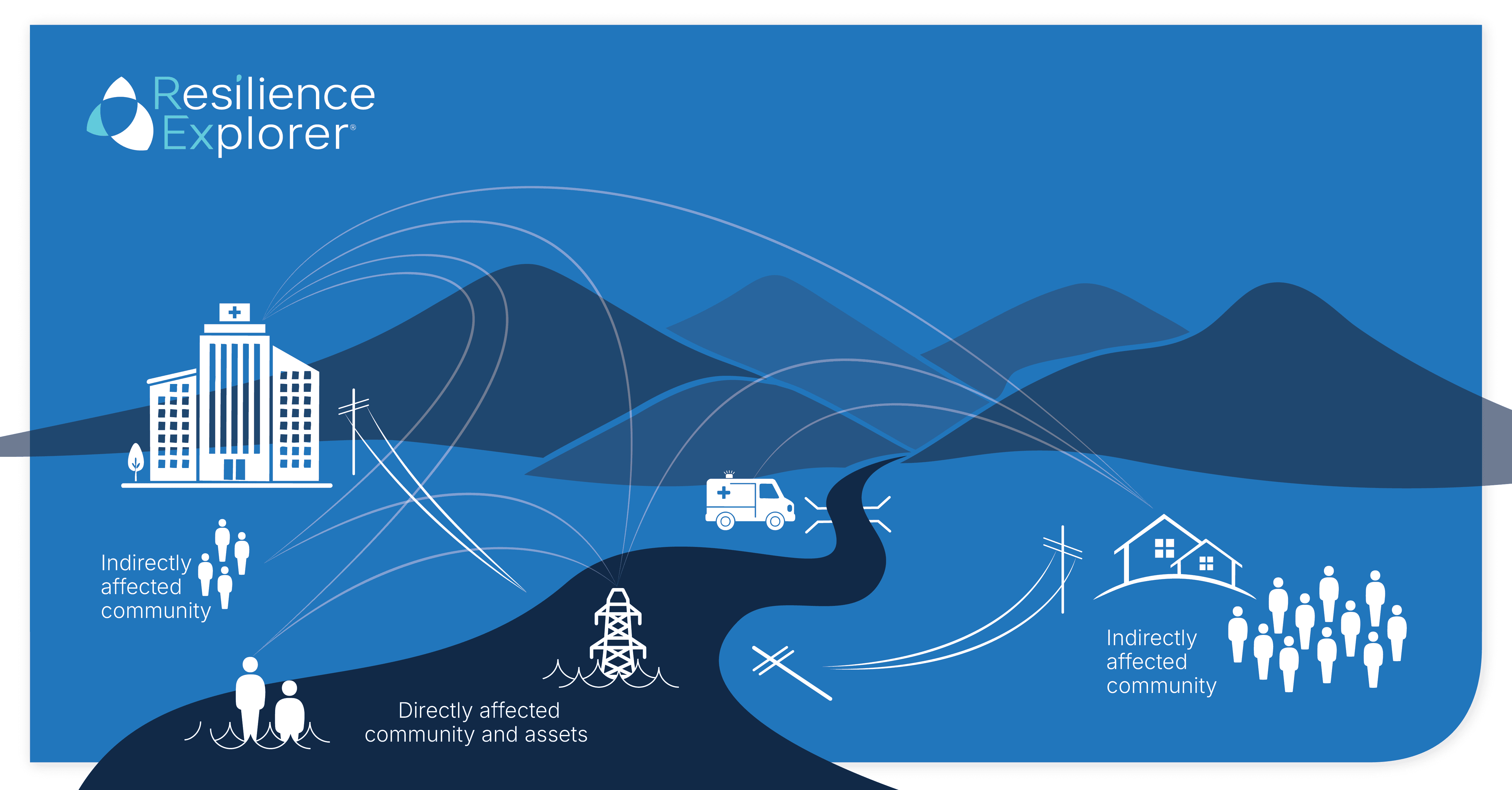
Coastal flooding provides a useful example. Once consequences begin to unfold, the issue quickly extends beyond floodwater itself. For example, property values may change, insurance may become less available, the cost to provide infrastructure may increase, public finances may come under pressure, and community cohesion may be affected if some households can adapt while others cannot. The risk therefore no longer sits within a single sector or organisation, but instead emerges from the interaction between multiple systems.
At the same time, these consequences are rarely viewed through a single lens. A local authority, infrastructure provider, insurer, business owner, iwi, environmental organisation, and resident may all assess the same situation differently because they are exposed to different consequences, operate over different timeframes, hold different responsibilities, and pursue different objectives. An insurer may focus on financial exposure, a council on community wellbeing, an infrastructure provider on service continuity, while iwi may place greater emphasis on relationships between people, place, and future generations. Understanding systemic risk therefore requires understanding both how consequences propagate through systems and how those consequences are experienced, valued, and interpreted by different stakeholders.
These differences are not external to the risk. Much risk analysis implicitly treats social, cultural, political, and distributional considerations as constraints that sit alongside the "real" risk. In practice, these factors often shape which consequences matter, who bears them, and whether proposed interventions are viewed as acceptable. As a result, stakeholders may support different actions even when they agree on the underlying evidence. Additional information can improve decisions, but it does not remove the need to address ambiguity, values, and trade-offs.
This has important implications for risk reduction. Many technical assessments imply that once risks are identified, the appropriate response becomes apparent. In systemic risk contexts, identifying risks and direct consequences seldom determines the best course of action. For example, debates about managed retreat, flood protection, infrastructure investment, insurance reform, and land-use planning rarely centre only on whether a hazard exists. More often, they revolve around questions of responsibility, fairness, timing, cost, identity, and future opportunity.
Questions such as the following become central:
Who should pay?
Who benefits?
Who bears residual risk?
Which outcomes are prioritised?
Whose values are reflected in the decision?
These dynamics help explain why interventions that appear effective from a technical perspective sometimes struggle to gain social or political support. A strategy that reduces expected economic losses may create unacceptable consequences for particular communities. Infrastructure investments that appear efficient at a regional scale may be viewed differently by those expected to bear local costs. Decisions that provide short-term benefits may transfer risks to future generations.
For practitioners and policymakers, the challenge is to assess systemic risk in ways that support decisions. That means understanding how consequences propagate through interconnected systems, how different groups experience and frame those consequences, and how interventions redistribute risks across sectors, places, and timeframes.
This is the central argument of our paper. Advancing systemic risk assessment requires methods that can represent interconnected consequences, uncertainty, ambiguity, trade-offs, intervention effects, and multiple legitimate perspectives. Without that, risk assessment can become too narrow: technically precise in one part of the system while missing the consequences that determine whether decisions are acceptable, robust, or fair.
For communities, this challenge will become increasingly important as climate adaptation, infrastructure investment, housing, insurance, environmental management, public finance, and economic development become more tightly coupled. Decisions made in one domain increasingly shape outcomes in another, often decades into the future. The question is whether our approaches to assessing risk are capable of supporting decisions in systems characterised by interdependence, uncertainty, ambiguity, and competing objectives.
Further Reading
Systemic Risk Assessment
Logan, T., Rachunok, B., Hardaway, K., Bristow, D., Reilly, A., Johnson, D., Johansson, J., Cremen, G., Boakye, J., & Schweizer, P. (2026). Advancing systemic risk assessment for complex, interdependent systems: A research agenda. Risk Analysis, 46(5), e70243. https://doi.org/10.1111/risa.70243
Renn, O. (2021). New challenges for risk analysis: systemic risks. Journal of Risk Research, 24(1), 127–133. https://doi.org/10.1080/13669877.2020.1779787
Systemic Risk and Communities
Sillmann, J., Christensen, I., Hochrainer-Stigler, S., Huang-Lachmann, J., Juhola, S., Kornhuber, K., Mahecha, M., Mechler, R., Reichstein, M., Ruane, A. C., Schweizer, P., & Williams, S. (2022). ISC-UNDRR-RISK KAN Briefing Note on Systemic Risk. International Science Council. https://doi.org/10.24948/2022.01
Risk Governance
Florin, M.-V., & Bürkler, M. T. (2017). Introduction to the IRGC Risk Governance Framework (Revised Version). International Risk Governance Council (IRGC). https://irgc.org/risk-governance/irgc-risk-governance-framework/
International Risk Governance Council (IRGC). Systemic Risks. https://irgc.org/risk-governance/systemic-risks/
What Is Systemic Risk and Why Does It Matter for Communities?
Systemic risk concerns how consequences emerge through interconnected systems and are experienced differently across communities, organisations, and sectors. This has important implications for climate adaptation, resilience, and decision-making under uncertainty.
